Showing posts with label trends. Show all posts

Tuesday, March 25, 2008

Lettered Walls


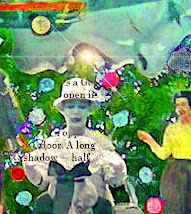
It doesn't look like this anymore. They changed it up again. But this is how it looked inside the Anthropologie on State street sometime mid November. I took the pictures because I love letters, and this wall seemed to be something out of one of my dreams. I love the idea of a world scattered with loose letters -- over the walls, overhead, underfoot. I want to make poetry installations like this -- poems you can walk through -- room to room to room. No hallways, no order -- only the flow and flux of letters joining and cleaving.

I secretly think that I am good at predicting trends. Well, let me rephrase that. I don't predict trends, but rather I feel like I begin to see themes/images/aesthetic sensibilities that have previously preoccupied my affection suddenly popping up everywhere a year or two later. This must happen to everyone, right? I mean, I must be prone to notice letters as a trend because I am interested in letters.

But I also love the look of birds and birdcages, and Anthropologie was also decorated with those. Anthropologie was also decked out with loads of Albert Serra images and wondercabinet-type knick-knacks.


And multi-colored silhouettes. I love that stuff.


But I don't necessarily love to buy things in Anthropologie. Here and there I find something I like, but I much prefer the decor to what they actually sell.

Anyway, I can't help but wonder what happens to all the stuff from these stores when they take it down. Does anybody know?

Store decor of this sort is really a trend in and of itself. Anthropologie's sister store, Urban Outfitters, also has lots of instore not-for-sale trimmings. The thing is, I actually sort of hate shopping lately. I mean, it's pretty stupid. But I do like the feel of some of these stores. I like the feel of Sephora -- like being in a big pink candy box -- but I only go in there to shop for other people. And even then, I feel like I'm drawn to packaging and color and design more than I am to the actually product. I wonder if this is related to the trend of virtual shopping where kids pay real dollars to clothe their avatars in virtual duds? Or to the counter trend of stores like etsy where you can find all sorts of unique, hand-made treasures?

I think shopping is ending. Or changing. I mean, we're getting near then end of the line, no? So this is my pseudo-trend prediction for today. I know that shopping won't really end, but a real shift is underfoot. What happens when these lifestyle stores interface with mass production? Or when stores produce mountains of poorly made, inexpensive goods that are the something like paper plates. Eventually, something has to give.

What do you think? Is shopping really satisfying?

Tracking the "It" Girl

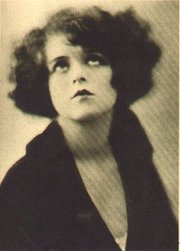
Clara Bow (left), original "It" Girl
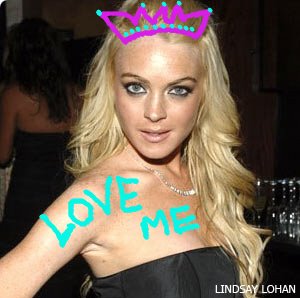
and Lindsay Lohan (below), "It" Girl, 2005


In case you haven't heard, former "mean girl"
Lindsay Lohan was voted (by what we are sure if a very scientifically accurate voting system ) Hollywood's "It" girl at the VH1 Big in '05 awards. The term "it girl" suggests that a girl is "it" and has "it." But what, pray tell, is "it"?

According to Wikipedia:

An It girl is a young woman famed for her good looks, but in recent years has come to describe a new up-and-coming young starlet who has recently broken into mainstream cinema. The term was coined after Clara Bow made the film It in 1927, which was a vehicle for her sex-appeal. Consequently, Bow was dubbed the "It girl", "It" being a euphemism for sex-appeal.

The pronoun "it" is most often used to refer to a previously mentioned, non-human object. Yet in this case "it" is meant to connotate a sexually desirable woman.
Interestingly, the word "girl" describes a female who has yet to come into her sexual maturity. In this sense, the term "It girl" works to suggest immaturity, pliability, and submission. The term "it" also suggests the possession of qualities that are otherwise mysterious or ineffable (akin to what American Idol judges refer to as "star quality"). Women have frequently been associated with the mysterious -- especially when it comes to their sexuality -- and this seems to be echoed in the term's lack of specificity. Moreover, the label "It girl," in it's elision of distinctive characteristics, also suggests an object of temporary attraction. Sooner or later the term "it" migrates to someone else. "It"'s lexical function is to suggest interchangeability.

But "it" has an obscene underbelly too, and is often used to stand in for something that otherwise "cannot be named." Kids talk about doing "it," and the doubly disturbing term "hitting it," with its creepy implication of both violence and objectification, seems to be gaining popularity. And the word "it" is also used to describe the terror without a name in Stephen King's novel It. Perhaps most disturbing are the of reports of victims of abuse being referred to as "it" by their abusers (i.e. the serial killer in Silence of the Lambs refers to his victims as "it;" and then there's that book A Child called "It"). "It" is also used to suggest gender ambiguity.

Interestingly, the first "it"girls were often presented as being entirely unique; they were perceived to be both an embodiment of everything that was appealing and desirable at a particular time, and also a portent of what was to come. Today's "it" girls seem more akin to a chain of paper dolls, suggesting a shift from the unique towards the generic.

Meet America's newest obsession: Hollywood It Girls. Smoking hot and barely legal, they live in multi-million dollar pads, zip around town in the coolest cars and date Hollywood boy-toys all the other girls would kill for- all while carrying around their pooches in thousand-dollar Louis Vuitton purses. And while these young starlets cross every velvet rope in town, nobody dares to cross them.
It's unsettling that one of the terms used to describe contemporary "It" girls is "barely legal." This is, after all, also the name of a porn magazine. Beyond the obvious narrative of class aspiration, their narrative appears also to be one of power -- they can cross any velvet rope and take any lover they desire. And yet the narrative of the contemporary "It" girl hardly seems to be one of empowerment. Consider this year nominees for the Big in 'O5 awards: L.Lo, Nicole, Paris, and Kritin Cavallari. At first glance, the only "it" these girls seem to share is a penchant for Smirnoff ice and an inability to gauge the proper sunglass size.

Contemporary "it" girls appear to dress and act the same; they seem to represent a sort of "dollification" of Hollywood. This seems eerily literal when one considers how many celebs also go under the knife in order to be more marketable. The identical fake tan, fake boobs, and fake hair of many "it" girls is both troubling and puzzling (see this amusingly cynical take on what it means to be an "it" girl). And more and more dolls are meant to be Hollywood it girls (see My Scene and Bratz). And those dolls are nasty.

There have been groups of sort of alternative "it" girls: Nico, Edie Sedgwick, Marianne Faithful, and Debbie Harry. Interestingly, women like Nico and Eddie Sedgwick were part of Andy Warhol's circle -- a scene that originally emerged as a sort of parody or facsimile of Hollywood. These types of "It" girls may also be related to the women in the films of Alfred Hitchcock and David Lynch. And to ingenues and femme fatales and vamps.

Besides being rich, "It" girls are also conspicuously white. Although Eartha Kitt and Halle Berry and Beyonce could be considered "it" girls, there still aren't enough roles for black women and minorities in Hollywood and minority women are still (sadly) less likely to appear on the cover of magazines.

And, perhaps the biggest question, why "It" girls and not "It" boys? More on that in a future post.

But for now, what do you think of the term "it" girl? Discuss.


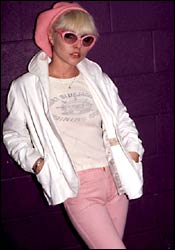
Debbie Harry, "it" girl


Related links:

Hollywood's shrinking "it" girls (splendora blog)
The It Girl (fiction)
"it" girls looking for love
The original "It" girl (Bint Magazine)

and when you google "it girl," half the results are about IT, which is often depicted as a big sausage party:

Why is IT all male?
Recruiting the new IT girls (BBC)
More IT Girls (BBC)

Monday, March 24, 2008

Tween Commerce


coming to malls everwhere: 'tween palace outfitters Dry Ice

The emergence of a "'Tween" market is old news, but for some reason it still took us awhile to really investigate how marketers were pitching to this demographic. Sure, we noticed all the new products coming out of manufaturers like Duff Stuff, PB Tween, and the empire known as American Girl. And we've always been interested in the way teen girls are represented in media, so we've perused a few issues of CosmoGirl and TeenVogue. But we've never really delved into this "tween" area of commerce -- the merchandise for 8-12 year old girls. Of course the demographic has always existed, but it wasn't until the late 9os that corporations began a serious campaign to court these consumers and attempt to brand this particular stage of development.

So yesterday the sad billionaire and I made our first trip inside a store called Dry Ice. We've looked in the windows of said store for many moons, but had always been too -- afraid? intimidated? discouraged? -- to enter. The store is an explosion of color and fluff, and every conceivable item the could be covered in faux fur is available within: furry phone? Got it. Furry clock? yes. Furry furniture?: check. They also had fun school supplies like bendy pencils and puppy-shaped erasers, desks and bookshelves in vibrant colors and patterns, imaginative lighting, and all types of colorful knick-knacks. Overall impression: thumbs up!! We're all for young girls personalizing their space. But there's more to this industry than rainbows and glitter and kittens; there's a dark side to all this too.

The 'tween market is undeniably gender-specific. While it seems perfectly reasonable for companies to market women's jewelry, make-up, clothing, and home decor to young girls, the trend seems to be in reverse for boys, with "kid" items (video games, animated cartoons) being marketed to male teens and men.

And while lots of products for tweens have a very positive message (games like Go Goddess!) and are designed to inspire creativity (poetry beads), we can't help but be a little concerned with the way so many of these items reinforce potentially negative notions about gender and sexuality. This is most obvious in attire: as clothing for younger girls becomes more provocative, boys' clothing remains virtually unchanged.

And we are by far most concerned for the youngest members of this market. You'd think memories of Jon Benet would make parents think twice before dropping 100 dollars on a half shirt, mini skirt, and high heels at Libby Lou. After Dry Ice, we visited one of these stores and let me tell you, these places are trully frightening. They are also colorful, but intsead of creativity-inspiring home decor, they're filled with trashtastic "beauty products," plastic tiaras, and outfits that seem to draw their inspiration from magazines like Barely Legal and Britney Spears' "Slave" video. There were also a handful of scantily clad girls prancing around the store when we were there, and we could only guess that the security guard at the front of the establishment was there to keep out potential predators. This could be Little Red Riding Hood come to life -- and the forests are the malls.

But the branding of the "tween experience" isn't going anywhere, and the term "tween" has come to embody its own set of meanings (see article "e-commerce's "tween years").

And though marketing for adults is undoubtedly manipulative, advertising for children in doubly potent. Children, unlike adults, do not have the same abilities to discern the difference between marketing spin and the "facts," and this essentially lays the groundwork for a whole new pedagogy of desire. As parents give their children more and more spending power, they essentially finance their children's training as life-long consumers of junk.


** check out Yahoo's group "Queens of Tween"message boards. We have a hard time believing that many of these messages are actually posted by tweens; it seems more likely that they are written by pernicious marketers hoping to drum up business. I mean, what 12 year old starts their posts with lines like, "Hot New Artist!!!"